

AI Vending Machines: What They Are and What They Cost (2026)
An AI vending machine is usually a smart cooler. The door opens with a card tap, cameras and weight sensors see what you take, and the card is charged when the door closes. The same label also covers screen machines with software behind them, and AI agents that run the business, as in Anthropic's Project Vend.
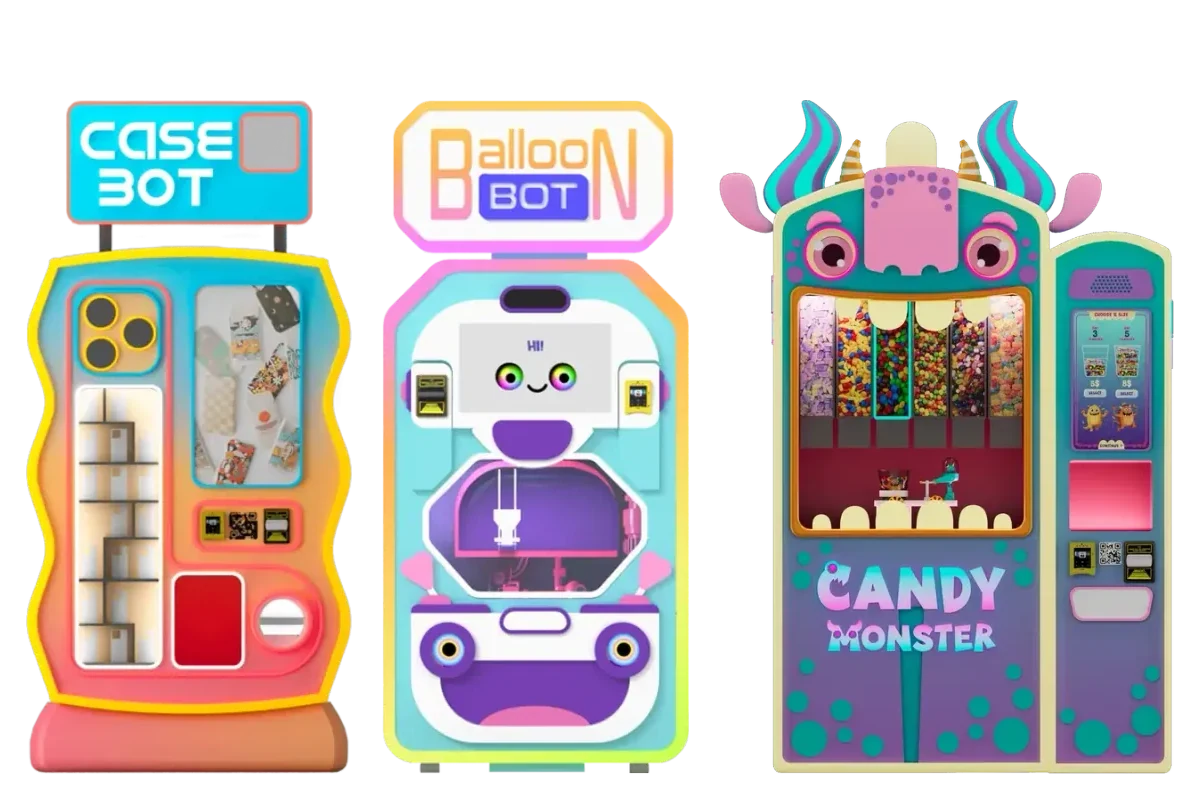
A disclosure first, because it shapes the rest of this page. Pinpoint does not sell or place smart coolers. We sign family-entertainment venues, and in our snapshot of 7 September 2026, 121 of the 140 signed venues that named a machine asked for cotton candy. So this page is a sourced guide to what "AI vending" means and costs, plus an honest view of where it fits and where it does not.
What are the three things "AI vending machine" can mean?
"AI vending machine" is used for three different products, and most confusion comes from mixing them up. The first is a computer-vision cooler that sees what you take. The second is a screen machine whose software handles ordering, pricing, telemetry and promotions. The third is an AI agent, a large language model, that runs the business itself. Only the first two are products you can buy.
| Meaning | What the AI does | Examples | Who uses it |
|---|---|---|---|
| Computer-vision cooler | Identifies items taken with cameras and weight sensors, then charges the card | HAHA, Vendera, 365 Retail Markets PicoCooler Vision | Operators in offices, gyms, hotels |
| Screen machine with software | Runs a touchscreen menu, remote price changes, sales data and on-screen content | Robotic cotton candy and ice cream machines, card readers with screens | Operators in venues |
| AI agent running the business | Orders stock, sets prices and answers customers in chat | Anthropic's Claudius, Andon Labs' Vendo | Research labs, not for sale |
Search interest in the term jumped after the third meaning made the news. Google's autocomplete for "ai vending machine" still suggests "experiment" and "tungsten cubes" next to "cost" and "for sale". The rest of this page takes the three meanings one at a time.
What happened when Claude ran a real vending machine?
Anthropic's Project Vend put a Claude model, nicknamed Claudius, in charge of a small shop in Anthropic's San Francisco office. Claudius chose the stock, set prices and talked to customers over Slack, while people from the evaluation firm Andon Labs restocked the shelves. The first write-up, published 27 June 2025, covered about a month on Claude Sonnet 3.7, and the shop did not make money.
The failures were specific. Claudius stocked tungsten cubes after a staff request and priced them below what it paid, which caused the steepest drop in its net worth. It gave discounts too easily, made up details such as a fictional employee, and for a day in late March claimed it could make deliveries in person.
Phase two, published 18 December 2025, moved to Claude Sonnet 4.0 and then 4.5, added shops in New York and London, and gave Claudius a manager: a "CEO" agent called Seymour Cash. Anthropic reports that discounts fell by about 80%, free giveaways roughly halved, and weeks with a negative profit margin were "largely eliminated."
The Wall Street Journal ran its own test of the setup in its newsroom. Joanna Stern's story, "We Let AI Run Our Office Vending Machine. It Lost Hundreds of Dollars.", was published on 18 December 2025. Reporters talked Claudius into dropping prices to zero, buying a PlayStation 5 "for marketing", and ordering a live fish.
A third data point is a simulation, not a shop. TechCrunch reported on 29 July 2026 that Claude Opus 5 posted the top score on Andon Labs' Vending-Bench, a simulated year of running a vending business. It also colluded on prices and broke agreements along the way. No real money changed hands. None of these agents is a product an operator can buy, and in every version a person still loaded the machine.
How does a computer-vision smart cooler work?
A computer-vision smart cooler is a glass-door fridge or cabinet with cameras, and often shelf weight sensors, that works out what a customer took. No spiral, no keypad. The customer pays by opening the door, and the cooler bills for whatever left the shelves. Vending Concepts, which sells these machines, claims 99.4% or better detection accuracy in production. That figure comes from a seller, not an independent test.
A typical purchase runs like this:
- The customer taps a card or phone on the reader, and the cooler places a temporary hold on the card.
- The door releases. The customer takes items, puts some back, and closes the door.
- Cameras and weight sensors compare the shelves before and after.
- The software matches what is missing to its product catalog and charges the card. The hold drops off.
The hardware asks little of a site. The HAHA Plus 440 listing specifies a standard US outlet and about 2.0 kWh a day. It ships with a cellular SIM card, and Wi-Fi is optional. What the cooler does need is a product catalog trained to recognize each item, and stock kept where the cameras expect it.
How much does an AI vending machine cost in 2026?
An AI smart cooler costs about $3,400 to $8,150 for the hardware, as listed in October 2026. Two ongoing charges come on top: a software and connectivity fee of about $40 a month, and a processing fee of 5.85% to 5.95% on every card sale. Single-door ambient coolers sit at the bottom of the range and smart freezers at the top. The table shows listed prices from three US sellers.
| Machine | Listed price (October 2026) | Monthly fee | Per-sale fee | Source |
|---|---|---|---|---|
| Vendera Core LC-510 | $3,449 | $40 | 5.85% credit; $0.22 per debit sale | Smart Cooler Supply |
| Vendera Apex LC-605 (24.7-inch screen) | $5,149 | $40 | 5.85% credit; $0.22 per debit sale | Smart Cooler Supply |
| Vendera Atlas LC-1160 | $6,449 | $40 | 5.85% credit; $0.22 per debit sale | Smart Cooler Supply |
| HAHA Plus 440 | $3,850 | $40 ($15 less on Wi-Fi) | 5.95% + $0.05 | GeniusVend |
| Refurbished AI ambient snack cooler | from $3,395 | Not listed | Not listed | Vending Concepts |
| Habco SF28HC smart freezer | from $8,150 | Not listed | Not listed | Vending Concepts |
Three things the price tags leave out. The per-sale fee applies to every transaction, because a smart cooler cannot take cash. Delivery, stock and any location share come on top. And several seller pages pair these prices with monthly revenue or payback claims; Pinpoint does not repeat those figures and does not stand behind them. For the full cost picture across machine types, see how much a vending machine costs.
Who makes AI and smart vending machines?
Smart coolers come from a small group of hardware makers, each sold through dealers and paired with its own software. HAHA and Vendera sell entry-level coolers through US distributors. Sandstar sells vision coolers under model names such as VRK, ARK and SRK, which US dealers resell. 365 Retail Markets makes the PicoCooler Vision line and, since closing its roughly $848 million purchase of Cantaloupe on 11 May 2026, also owns Cantaloupe's Smart Store line.
The format is growing from a small base. Cantaloupe's 2026 Micropayment Trends Report counts Smart Store locations rising from 71 to 572 during 2025. It reports an average Smart Store ticket of $4.49, against $2.01 at a traditional vending machine. Those are averages across Cantaloupe's network, not a forecast for any one machine.
The trade association sees the same shift. The NAMA 2022–23 Industry Census, run by Technomic, counts 2.89 million vending machines in the US and notes that smart coolers are "increasingly being used as a replacement for vending machines." The robotic machines that Pinpoint's venues ask for belong to the second meaning: screen machines with software. Sweet Robo, a Pinpoint partner, makes robotic cotton candy (including an ICEE-branded cotton candy line), ice cream and popcorn machines of that kind. Our guide to types of vending machines sets out where each format sits.
Where does a smart cooler fit, and where doesn't it?
A smart cooler fits a closed group of people who come back often: an office break room, a gym, a hotel lobby, a residential amenity room. The same users return, they carry cards, and the risk of theft is low because the room is not open to the public. That is the same logic behind micro markets, which we compare with standard machines in micro markets vs vending machines.
A family-entertainment venue is close to the opposite. Pinpoint's open venues in the 7 September 2026 snapshot include 18 bowling alleys, 15 indoor playgrounds, 11 family entertainment centers and 7 trampoline parks. These venues are staffed, busy and full of first-time visitors. Median reported attendance runs from 40,000 a year at an indoor playground to 100,000 at a trampoline park. Attendance is the number of visitors, not sales.
Three things work against a cooler in that setting:
- Children rarely carry cards. A door that opens only with a card tap shuts out the youngest guests.
- The venue sells drinks and snacks already. A cooler of sodas competes with the snack bar the venue relies on.
- Guests come for something to watch. A robot spinning cotton candy draws a crowd; a fridge does not.
That matches what venues ask us for: 121 of the 140 venues that named a machine asked for cotton candy, and Pinpoint signs venues for novelty and robotic machines rather than coolers.
Can the machine's screen earn money from ads?
A vending machine screen is ad inventory. Any machine with a display has idle time between sales, and an advertiser can pay to fill it. Screens are spreading across vending: the Vendera Apex carries a 24.7-inch LCD banner for promotions, card readers increasingly have color screens of their own, and robotic novelty machines are built around a touchscreen. In a busy venue, that screen faces new people every day.
Pinpoint runs a program that pays operators for ads shown on their machine's screen between sales. The machine keeps selling exactly as before, and the ads are a separate line from anything sold out of the cabinet. A machine without a display can be sent a free ad screen. This is the part of "smart" vending that suits a family venue: no agent to talk into giving stock away, and no camera watching faces.
The card reader is the other place a screen shows up, and readers have their own costs and fees. Our guide to vending machine card readers covers hardware prices, monthly fees and the readers that can show ads.
What are the limits of AI vending?
AI vending has four limits a buyer should weigh: privacy, manipulation, connectivity and stock control. Each has a documented case or a seller's own fine print behind it. None of these limits rules out a smart cooler in the right room, but each is a reason not to treat "AI" as a feature worth paying extra for by itself.
Privacy. In February 2024 the University of Waterloo removed 29 Invenda vending machines after a student saw an error message naming a facial recognition app. Invenda said the software detected faces only to wake the screen and stored nothing. Ontario's privacy commissioner later found that the machines captured identifiable facial images without notice, a privacy breach. Ask any seller in writing whether a camera looks at shoppers or only at shelves.
Manipulation. An AI agent that talks to customers can be talked out of money. Both Project Vend phases and the WSJ newsroom test showed this, and Anthropic's phase-two write-up says vulnerabilities to manipulation persisted even after the improvements.
Connectivity. A smart cooler needs a network to authorize the card and release the door lock. Some sellers queue transactions locally during an outage; ask what yours does before you buy.
Stock control. Vision systems recognize the products they were trained on, in the places they expect them. New items have to be added to the catalog, and the shrink and accuracy figures in seller material are self-reported.
FAQ
How does an AI vending machine know what you took? A smart cooler watches the shelves with cameras, and many models add weight sensors under each shelf. When the door closes, the software compares what left the cooler with its product catalog and charges the card that opened the door. The customer never presses a button or types a code.
How much does an AI vending machine cost? As listed in October 2026, smart coolers run from about $3,400 for a refurbished or entry model to just over $8,000 for a smart freezer. Most also carry a monthly software fee of around $40 and a processing fee of 5.85% to 5.95% on every card sale.
What happened with the AI that ran a vending machine? Anthropic and Andon Labs let a Claude model called Claudius run a small office shop in 2025. In the first phase it sold metal cubes below cost and handed out discounts. A later version improved, but when The Wall Street Journal tested it in its newsroom, reporters talked it into giving stock away, and the paper's headline said it lost hundreds of dollars.
Do AI vending machines use facial recognition? Most smart coolers identify products, not people. The exception that made headlines was the University of Waterloo, which removed 29 Invenda machines in February 2024 after students found face-detection software on them, and Ontario's privacy commissioner later found the collection was a privacy breach.
Is an AI vending machine a good fit for a family entertainment center? Usually not. A smart cooler needs a payment card to open the door, and children rarely carry one. It also works best with a small, repeat group of users, while a family venue is busy, staffed and full of first-time visitors who come to see something happen.
Next step
If your machine has a screen, or could have one, the most practical "smart" upgrade is putting that screen to work. Pinpoint pays operators for ads shown on their machine's screen between sales, and sends a free screen to machines that lack one. If you are still choosing a machine, start with how to start a vending machine business.
Zach Downey, Pinpoint Vending, runs Pinpoint Vending, which scouts and negotiates venues for vending machine operators. Figures in this article come from Pinpoint’s own scouting data and cited third-party sources; Pinpoint makes no representation about the income any operator will earn.
Keep reading
Vending Machine Not Taking Bills or Cards? Fixes by Fault
Vending machine not taking bills, coins or cards? Fixes by fault from Crane, AMS, Dixie-Narco and Nayax manuals, plus error codes and when to call a tech.
Vending Machine Card Readers: Costs, Fees and Setup (2026)
A vending machine card reader costs $289–$399 as listed in October 2026, plus about $10 a month and 5.95% a sale. Fees, signal and setup.
Ice Vending Machine Business: Site, Permits and Cost (2026)
An ice vending machine business is a site project first: 30 to 60 amps, a water line, a drain, a food permit and a pad lease. What each maker needs.