

Micro Markets vs Vending Machines: Which Can You Start?
Micro markets out-sell vending machines at the same site, but they need a closed, trusted workplace of roughly 150 or more staff, $15,000 to $50,000 in build-out, and tolerance for 2–10% shrink. A single machine needs one outlet and one venue. For a first-time operator, venue access decides this, not revenue.
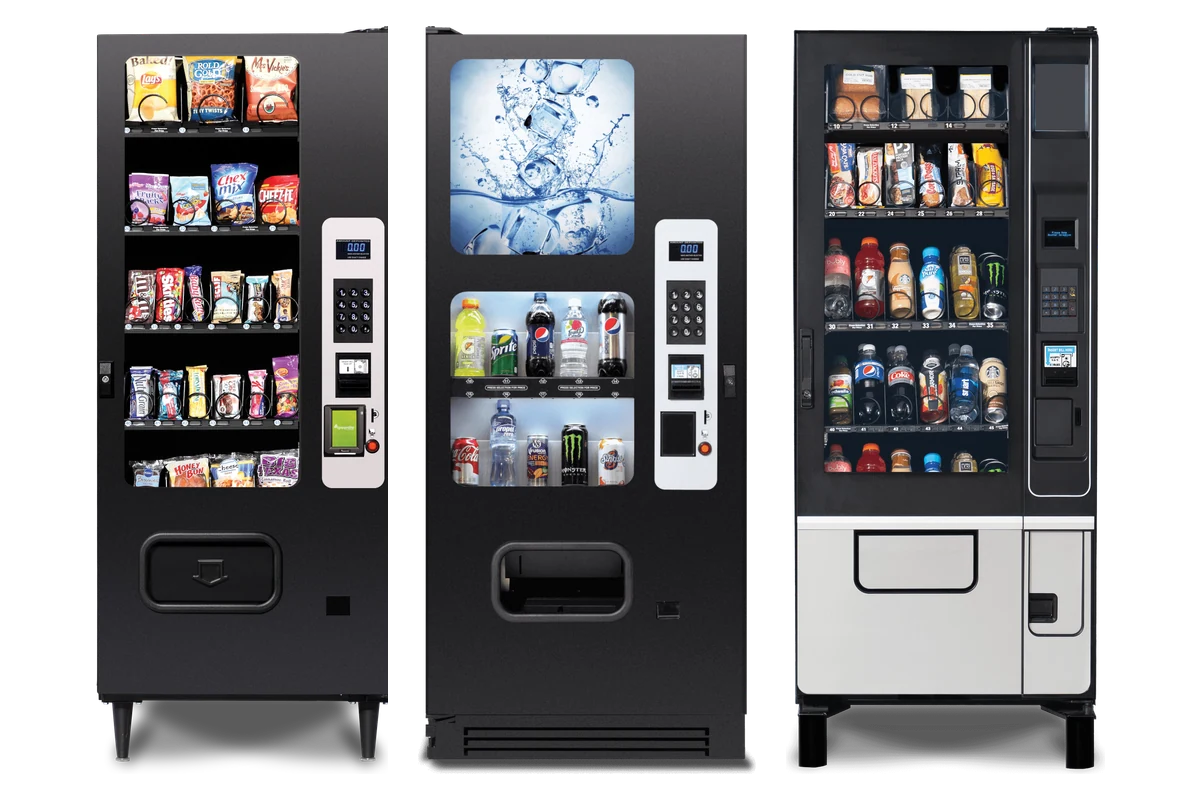
Most comparisons of these two formats rank them by revenue per location, which is the wrong axis for someone who has not yet signed a venue. This post ranks them by what a venue will agree to. If you want the taxonomy of every format rather than this head-to-head, read types of vending machines; if you are earlier still, start with how to start a vending machine business.
What is the difference between a micro market and a vending machine?
A micro market is an unattended open store — coolers, snack shelving, and a self-checkout kiosk installed into a breakroom, with nothing between the buyer and the product. A vending machine is a sealed cabinet that takes payment before it releases anything. That single difference in enclosure drives every other difference below: capital, venue type, shrink, product range, and service load.
| Factor | Vending machine | Micro market |
|---|---|---|
| Capital to start | One cabinet, roughly $1,800–$8,000 new depending on type | $15,000–$50,000 per build-out (The Vending Club) |
| Venue requirement | One outlet and about three feet of wall | A dedicated room or wall, multiple outlets, network, and a floor-space concession |
| Buyer population | Anyone who walks past, including strangers | A closed, repeat, accountable group — typically 50–200 regular users, and clearly better above 150 |
| Shrink exposure | Low; product sits behind a locked door | 3–5% by most operators' own estimate, and far higher during theft spikes |
| Product range | 30–45 selections, or one made-to-order treat | Fresh food, sandwiches, salads, drinks, snacks, sundries |
| Service burden | Restock on a route schedule, often weekly or fortnightly | Two to four visits a week, plus spoilage management on fresh food |
| Getting a yes | Permission to plug in a machine | A landlord or employer agreeing to give up floor space and vouch for their own staff |
Cost figures above are third-party 2026 estimates and vary by vendor, region, and specification. Pinpoint Vending places machines and publishes no earnings figures for either format.
How much capital does each format need to start?
A micro market is a construction project with a payment terminal in it. The Vending Club's 2026 guide breaks a $15,000 to $50,000 install into a kiosk at $3,500–$7,500, refrigeration at $2,000–$6,000, shelving at $2,000–$5,000, security at $1,500–$4,000, and $1,000–$3,000 of opening inventory — before freight, installation labour, network runs, and first-month spoilage.
A single vending machine is one line item. New units run roughly $1,800 for a compact impulse machine to $8,000 for a full beverage cabinet, and the full breakdown sits in how much a vending machine costs. The gap is not marginal — it is the difference between buying a machine and financing a small fit-out across several sites before any of them proves out.
What kind of venue will actually say yes to each format?
Venue access, not revenue per head, is the constraint that decides this for most first-time operators. A micro market needs a venue with a closed, repeat, accountable population: a workplace where the same people return five days a week, know each other, and can be reached by an employer if the kiosk logs a cancelled transaction. That is a specific and scarce kind of building, and it is not the kind of venue most new operators are being offered.
Pinpoint's own signed inventory makes the point concretely. Of the 157 open signed venues, 90 carry a category label, and the four largest are bowling alleys (18), indoor playgrounds (15), family entertainment centres (10), and trampoline parks (7). Every one of those is public, transient, and anonymous — walk-in families, a different crowd every session, nobody's employer on the hook. An unattended open-shelf market in that environment has no trust mechanism at all. An enclosed machine does, because it takes the money first.
That is the strategic point the revenue comparisons miss. The venues most reachable to a new operator are exactly the venues where the micro market model does not function, and the venues where it does function — large corporate breakrooms — are the hardest for a first-time operator to reach and the most likely to already be served by an incumbent. If entertainment venues are the ones you can get, read vending machines in trampoline parks and vending machines in apartment complexes for how those two populations differ.
How bad is shrink in a micro market?
Shrink is the number that decides whether a micro market works, because an open-shelf store with no staff depends entirely on people choosing to pay. Most micro market operators put their own shrink in the 3% to 5% range, according to Vending Market Watch's reporting on micro market security, with published guides citing a wider 2% to 10% band depending on the site.
The tail is what hurts. During the Q1 2023 theft spike, the same reporting notes some operators saw losses reach 25%, 30% or even 50% at individual markets, most often through the same method: a buyer ringing items at the kiosk, cancelling the transaction, and walking out. Research summarised by William Blair on unattended retail reaches the structural conclusion — theft has confined micro market rollout to secure workplace settings where trust and surveillance are manageable.
A vending machine has close to none of this exposure, because the product never leaves the cabinet until the payment clears. That is not a small operational advantage for someone with one or two units and no cushion to absorb a bad quarter.
Is a smart cooler the middle option between the two?
A smart cooler is the bridge format, and it is the one that actually grew. It holds far more product than a spiral machine and lets a buyer see and handle the item, but it locks the door, authorises the card first, and charges for whatever leaves — so it gets much of the micro market's range without the micro market's trust requirement.
The 2026 State of the Vending and Micro Market Industry report from Automatic Merchandiser and VendingMarketWatch found industry revenue reached an estimated $40.04 billion in 2025, up 18.3% from $33.85 billion in 2024, with smart coolers at 33.5% of equipment deployed by respondents and more than half of operators running them. Over the same period micro market expansion cooled sharply: 38% of respondents added micro market locations in 2025 and 52.4% reported no change, against 84% reporting growth in 2023.
Read that as a format decision, not a fashion. Operators are placing coolers at sites that a few years ago would have been micro markets, because a locked door solves the problem an open shelf creates.
Which format has the heavier service burden?
Micro markets carry a service load closer to a small shop than a route stop. Because they stock sandwiches, salads, yogurt, and other perishables, markets typically need two to four visits a week, per The Vending Club, and each visit involves date-checking and pulling expired stock as well as refilling. Spoilage is a running cost that a shelf-stable machine simply does not have.
A vending machine is restocked on a route schedule set by its sell-through, not by expiry dates, and one person can service several in a day across a sensible radius. The practical cadence and how to set it is covered in how often to restock a vending machine. The service difference compounds with distance: a market that needs four visits a week has to be close to you, which narrows your map far more than a machine does.
Which format should a first-time operator start with?
A first-time operator should start with one machine, in the venue they can actually sign, and treat a micro market as a later move that requires a specific kind of account. The sequencing argument is not about ambition; it is that a micro market's economics depend on a closed workforce, and a closed workforce is not usually what a new operator is offered first.
There is also a proving-out argument. One machine tests whether you can pick product, keep a service schedule, and hold a venue relationship, at a cost you can absorb if the site underperforms. A market tests the same things at ten times the capital, in a building that may already have an incumbent. If you are still deciding whether either version of this business is for you, is a vending machine business worth it works through the honest case. Pinpoint's terms and deposit are on the pricing page.
FAQ
Are micro markets better than vending machines? Micro markets sell more per person at the same site, but only in a closed workplace with a known, repeat population. In a public or transient venue the open-shelf format cannot control shrink, so a machine is the better format there regardless of the sales ceiling.
How much does it cost to start a micro market? Third-party 2026 estimates put a micro market build-out at $15,000 to $50,000, covering the kiosk, refrigeration, shelving, security, and opening inventory. A single vending machine is a fraction of that and needs one standard outlet.
What is a normal shrink rate for a micro market? Most operators put their shrink in the 3% to 5% range, and guides cite 2% to 10% depending on the site. During a 2023 theft spike some operators reported losses reaching 25%, 30% or even 50% at individual markets.
Can you put a micro market in a bowling alley or trampoline park? An unattended open-shelf micro market is a poor fit for a bowling alley, trampoline park, or family entertainment centre, because the crowd is public, transient, and anonymous. Those venues suit an enclosed machine that takes payment before it releases the product.
Is a smart cooler a good middle option? A smart cooler sits between the two: it holds far more product than a spiral machine but locks the door and charges the card before it opens. Smart coolers reached 33.5% of equipment deployed by operators surveyed for the 2026 State of the Industry report.
Next step
Decide the format by the venue you can get, then look at what placing one machine involves. Pinpoint's pricing page sets out the deposit, the terms, and what is included when a machine goes into a signed venue.
Zach Downey runs Pinpoint Vending, which scouts and negotiates venues for vending machine operators. Figures in this article come from Pinpoint’s own scouting data and cited third-party sources; Pinpoint makes no representation about the income any operator will earn.
Keep reading
Vending Machine Sales Tax by State (2026): 20 States
Vending sales tax differs by state: 33% of receipts in California, 57% in Washington, 50% in Texas. The rule for 20 states, from revenue departments.
Vending Machine Business Plan: Lender-Ready Template 2026
A full vending machine business plan structure, plus the location-acquisition number most templates get wrong: Pinpoint signs one venue per 80 scouted.
How Often to Restock a Vending Machine (2026 Method)
How often to restock a vending machine is capacity divided by daily sell-through, not a weekly route. The arithmetic, plus venue foot traffic.