

Vending Machines in Trampoline Parks: What 7 Hosts Ask
Trampoline parks are the highest-traffic venue type in Pinpoint's signed inventory: a median of 100,000 annual visitors across the 6 parks that report a count, against 65,000 for family entertainment centers. All 7 signed parks asked for a cotton candy machine, and the 6 with a share on file signed at 40%.
Most guides fold trampoline parks into "entertainment venues" and move on. This post treats them as their own venue type, because the waiver desk, the sock rule, the posted court rules, the weekend party rhythm and the franchise approval layer all change where the machine goes and who can say yes. The Pinpoint figures come from the public listings snapshot of 7 September 2026, covering 157 signed venues across 34 states. For the broader category — arcades, bowling alleys, family entertainment centers and trampoline parks together — start with the guide to vending machines in family entertainment centers, and for the whole placement process, the pillar guide to how to find vending machine locations.
How much foot traffic does a trampoline park get?
Trampoline parks report the highest visitor counts of any venue category in Pinpoint's signed inventory. Across the 6 signed parks that report an annual figure, the median is 100,000 visitors a year, and the range runs from 20,000 in Appleton, Wisconsin to 150,000 at three parks in South Carolina and Georgia. Be careful with that number: it describes 6 venues, not an industry.
| Venue category | Signed listings | Listings reporting a count | Median annual visitors |
|---|---|---|---|
| Trampoline park | 7 | 6 | 100,000 |
| Family entertainment center | 10 | 9 | 65,000 |
| Bowling alley | 18 | 16 | 50,000 |
| Indoor playground | 15 | 11 | 40,000 |
Two caveats matter more than the ranking. First, only 72 of the 157 open venues in the snapshot report a visitor count at all, so every median here is drawn from the minority that volunteered one, and none of them cover all 157. Second, the counts are self-reported by the venue at signing. A park that sells 60- and 90-minute jump passes through a ticketing system knows its number precisely; a park estimating from parking turnover does not.
What the sample does say clearly is that the spread inside the category is wider than the gap between categories. The 20,000-visitor park in Appleton and the 150,000-visitor park in Hiram, Georgia are both trampoline parks, both signed at 40%, and both asked for a cotton candy machine. The category tells you where to look; it does not tell you which building is worth the drive. Scoring an individual site is covered in how to know if a vending machine location will be profitable.
Where does the vending machine go inside a trampoline park?
A trampoline park has three good positions for a vending machine and two bad ones, and the layout is different enough from an arcade or a bowling alley to be worth walking before you agree. The three that work — the waiver desk, the party-room corridor and the parent viewing area — all sit on the lobby side of the sock line, where food is allowed and people are standing still.
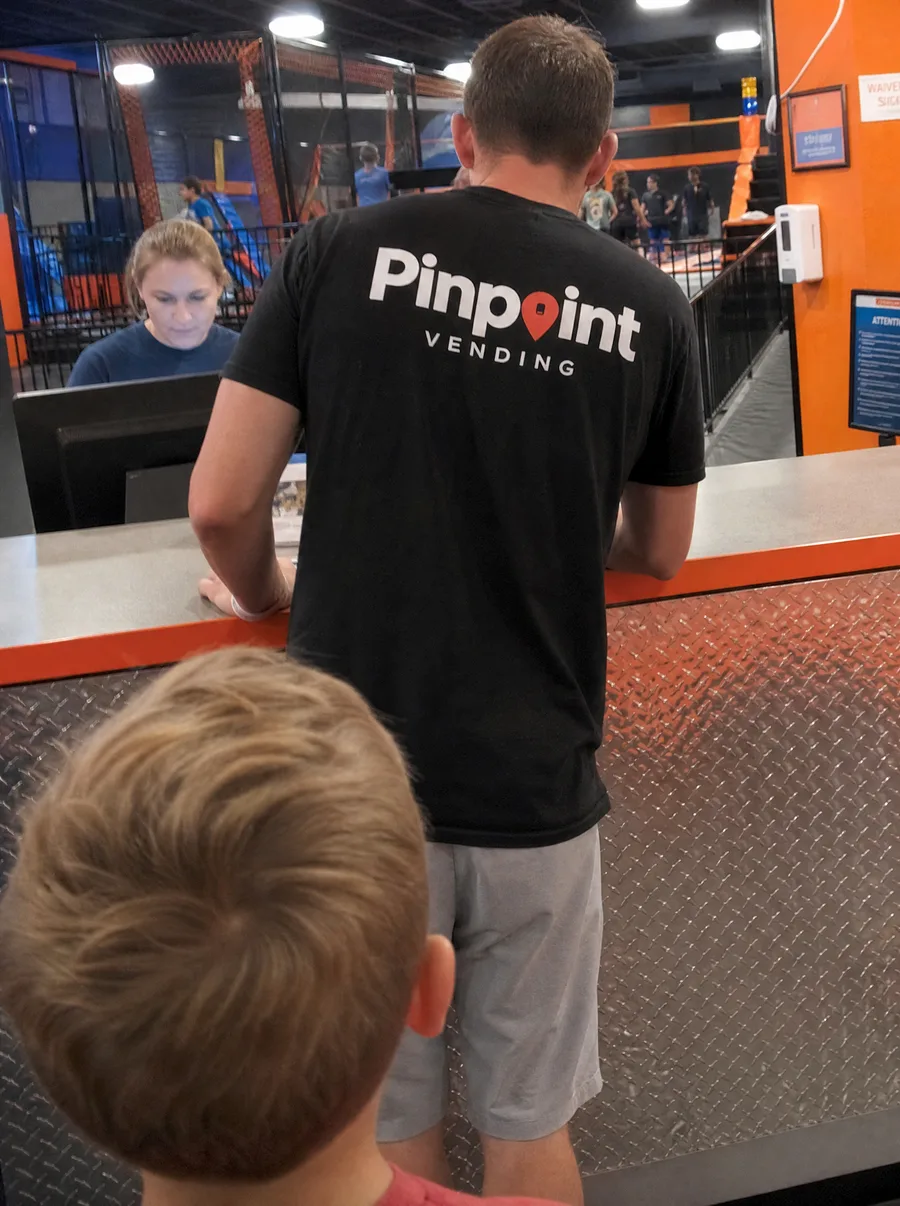
The waiver desk. Every family entering a trampoline park stops here twice: once to sign a waiver and once to buy grip socks. ROLLER's 2025 attractions benchmark found 90.9% of trampoline parks use digital waivers, which means a parent standing at a tablet for two or three minutes with a child beside them. That is a queue rather than a doorway, and a queue is what a vending machine needs: people standing still, for minutes, with a child asking.
The party-room corridor. Party groups are the largest bookings a trampoline park takes. The same ROLLER data puts venue-manager bookings at 10.1 guests against 2.1 for a point-of-sale walk-up, so a party moving from the court to the cake room is ten children in one corridor at one time, twice in a session.
The parent viewing area. Adults who are not jumping sit for the full 60 or 90 minutes with nothing to do. They have the payment method and the boredom, and they are the ones who buy a second round on the way out.
What does not work is the entrance vestibule, where arriving families are focused on waivers, shoes and wristbands and leaving families are focused on the car, and the court floor itself, which is covered in the next section. A machine tucked past the waiver desk but before the sock counter catches families on both legs of the visit.
Practicalities are the same as any venue: a standard 110V outlet within a few feet with no cord across a walkway, a cellular or Wi-Fi signal for cashless payment, about three feet of clearance for a queue, and a position a staff member can see from the desk so damage is reported the same day. Walk the spot on a Saturday afternoon, not a Tuesday morning.
Do trampoline park safety rules restrict where a machine can go?
Trampoline park safety rules do restrict placement, and the restriction is absolute rather than negotiable. Trampoline park rules put a hard boundary around where a machine can stand. Parks post jump rules that keep food and drink off the court surface, and they swap street shoes for grip socks at the edge of the jump area. Both rules point the same way: the machine belongs on the lobby side of the sock line, never past it.
That single rule settles the placement question. A cotton candy or ice cream machine cannot sit on or beside the jump area, because the product it sells is banned three feet away. Two further consequences follow:
- The sock line is a hard boundary. Parks require grip socks and ban street shoes on the court, so the building splits cleanly into a shod lobby and an unshod court. Your machine belongs on the shod side, where a parent can hold a drink and a child can eat.
- Staffing and clearance. Court monitors work the floor and need sightlines to the beds, which makes the space beside a court operational rather than spare. A manager who has to watch the court will not give you that wall, and should not.
None of this is an obstacle to placement — it is a map. Every Pinpoint trampoline park listing that specifies a spot puts the machine in the lobby, at the desk or in the viewing area. Ask the general manager one question on the walkthrough: "which side of the sock counter is this?"
When does trampoline park traffic actually arrive?
Trampoline park traffic is concentrated, not spread. Parties and school-holiday sessions load the weekend, and a Tuesday at 11am in the same building can be near empty. That matters for two decisions an operator makes: when to visit for the pitch, and how to set a restock interval that does not leave the machine sold out during the busiest four hours of the week.
Party bookings are the reason. ROLLER's 2025 trampoline data has venue-manager bookings averaging 10.1 guests against 2.1 at the counter, and its 2026 benchmark reports that guests at venues offering parties return 41% of the time against 26% at venues that do not. A park with 50 parties across a weekend is running a different business on Saturday than it is on Wednesday.
Two practical consequences:
- Pitch on a weekday between 10am and 1pm. The manager is on site, the morning clean is done, and the after-school rush has not started. Never on a Friday evening or a Saturday.
- Set the restock interval against the weekend peak, not the weekly average. A machine that empties on Saturday afternoon is invisible for the rest of the weekend and is also the version of your machine that the party coordinator remembers. The arithmetic is in how often to restock a vending machine, and how far you can reasonably drive to do it is in vending machine service radius.
Who signs the agreement at a trampoline park?
At an independent trampoline park the general manager decides and the owner signs, often within the same week. At a franchised park the franchisee owns the decision but may need the franchisor's approval for an outside vendor. At a company-owned park inside a chain, the decision belongs to a regional or corporate buyer you will rarely reach by walking in. Work out which of the three you are standing in before you spend a visit.
The franchise question is sharper in trampoline parks than in bowling or arcades, because the biggest brands in the category are franchise systems. Franchise Chatter's 2026 adventure park franchise rankings put Sky Zone at 252 locations, Urban Air Adventure Park at 205, Altitude Trampoline Park at 86 and Launch Entertainment at 29. The ownership split is what matters to you:
| Chain | Locations (2026) | Company-owned | Who you would need |
|---|---|---|---|
| Sky Zone | 252 | 121 | Corporate for roughly half; the franchisee for the rest |
| Urban Air | 205 | 4 | The franchisee, subject to franchisor approval |
| Altitude | 86 | 10 | The franchisee, subject to franchisor approval |
| Launch | 29 | 1 | The franchisee |
Urban Air running 4 of its 205 parks itself means the person who decides is a local owner-operator you can meet. Sky Zone running 121 of 252 means roughly half that chain is a corporate conversation with a procurement clock measured in quarters. All 7 of Pinpoint's signed trampoline parks are in smaller markets — Laurens and Anderson in South Carolina, Hiram in Georgia, Oxford in Mississippi, Pikeville in Kentucky, Appleton in Wisconsin, Oceanside in California — which is where independent and single-unit franchise ownership concentrates.
Three questions to ask on the first visit, in this order: is this park independent, franchised or company-owned; does your franchise agreement require approval for an outside vending vendor; and who holds the contract on the arcade and redemption games, if there are any, and does it cover vending. The last one is the exclusivity trap covered in the family entertainment center guide. The approach script is in how to approach a business about placing a vending machine, and what the signed agreement should contain is in vending machine contract template.
The party coordinator does not sign anything and is still worth ten minutes. They know the weekend calendar, which corridor the groups actually use, and whether the manager has turned down a vendor recently.
What machine do trampoline parks ask for?
Every trampoline park in Pinpoint's signed inventory asked for cotton candy. All 7 named a cotton candy machine specifically: the Cotton Candy VX2 on three listings, the Cotton Candy VX on three, and the ICEE Cotton Candy on one. Not one asked for a snack or drink machine, which is unusual even against the wider snapshot, where 121 of the 142 listings naming a machine — 85% — ask for cotton candy.
The reasons are specific to the venue rather than to the product:
- It does not compete with the café. Trampoline parks sell pizza, slushies and bottled drinks at a counter. Spun sugar is made on demand and is not on that menu, so the manager is adding revenue rather than splitting it.
- It survives the party rhythm. No refrigeration, no perishable stock, nothing that spoils across a quiet Wednesday.
- It is theatre in a building that sells theatre. The machine spins the sugar in front of a child who has been watching other children fly for an hour.
The venue share on those agreements is consistent too: of the 7 signed parks, 6 have a share on file and all 6 are at 40% of machine revenue after expenses. That sits at the top of Pinpoint's usual 30–40% band, which is what the highest-traffic category in the inventory should look like. Where cotton candy works best across all nine venue types is ranked in best places for a cotton candy vending machine.
Do visitor counts tell you what a machine earns?
No. A visitor count tells you how many people walked through a building in a year. It says nothing about how many stopped at a machine, what they paid, what the product cost, what the venue's 40% took, or what a month of weather or a closed school week did to the number. Pinpoint publishes no earnings figures for any venue, trampoline parks included, and neither should anyone selling you one.
This is not caution for its own sake. Pinpoint charges a $1,000 refundable deposit and a $100 monthly licence fee, which makes the offer a business opportunity under the FTC Business Opportunity Rule (16 CFR Part 437). The rule requires a written disclosure document at least seven calendar days before you sign or pay, and it bars earnings claims that are not backed by written substantiation handed to you at the same time. We have visitor counts. We do not have per-machine revenue by venue type, so we say nothing about it.
The useful way to read the 100,000 figure is as a comparison, not a forecast: a trampoline park in this sample sees more people in a year than a bowling alley or an indoor playground in the same sample. That is a reason to look at the category. It is not a number to multiply by anything. If you want the honest range of what the business can look like, is a vending machine business worth it and how to write a vending machine business plan both work from costs rather than promises.
How does Pinpoint place machines in trampoline parks?
Pinpoint scouts the park, negotiates the share, signs the host agreement itself, and licenses the space to an operator. Trampoline parks are a small and high-demand slice of that inventory: 7 of the 157 open signed venues, spread across South Carolina, Georgia, Mississippi, Kentucky, Wisconsin and California, all signed between 8 July and 11 August 2026 and all still waiting for a machine.
The scale behind that number is the reason operators hand this step off. Pinpoint has scouted 26,311 venues to sign 329 — about one signed venue per 80 scouted — and 185 of those have a machine placed. The median open listing has been waiting 62 days for an operator. Terms are on the pricing page and are the same for every venue type:
- Up to 2 qualified locations presented, with the venue share shown on each before you choose; turn them down and the search continues at no extra cost.
- A $1,000 refundable deposit, returned in full if we do not place you within 6 months, or after 12 months placed.
- A $100 monthly licence fee that starts only when the machine is installed and running.
- A 12-month minimum term at the location, and a rematch at no charge if the machine is removed in the first year through no fault of yours.
Open trampoline park listings, with the state, the city, the share and the machine requested, are on the vending locations page.
FAQ
Can you put a vending machine in a trampoline park? Yes, and trampoline parks ask for them. Pinpoint has 7 signed trampoline parks waiting for an operator, in South Carolina (2), Georgia, Mississippi, Kentucky, Wisconsin and California. All 7 requested a cotton candy machine. The one constraint is the court itself: parks post jump rules that keep food and drink off the trampoline beds, so the machine goes on the lobby side of the sock line.
How much foot traffic does a trampoline park get? Of the 6 Pinpoint trampoline parks that report an annual visitor count, the median is 100,000 a year and the range runs from 20,000 to 150,000. That is the highest median of any Pinpoint venue category, above family entertainment centers at 65,000, bowling alleys at 50,000 and indoor playgrounds at 40,000. Only 72 of 157 open venues report a count at all, so these are self-reported figures from a small sample, not an industry average.
Where should a vending machine go inside a trampoline park? Three places work: beside the waiver desk where every arriving family stops to sign and buy grip socks, in the party-room corridor, and in the parent viewing area where adults sit for the whole session. The entrance vestibule and the court floor do not. Arriving families are focused on waivers and socks, and the court bans food outright.
Who decides whether a trampoline park takes a vending machine? At an independent park the general manager decides and the owner signs, usually in the same week. At a franchised park the franchisee owns the decision but the franchise agreement may require the franchisor to approve outside vendors, so ask before delivering anything. At a company-owned park in a chain it is a regional or corporate buyer you will rarely reach cold.
Are trampoline parks mostly franchises or independents? Mostly franchises at the top end. Franchise Chatter's 2026 rankings put Sky Zone at 252 locations, Urban Air at 205, Altitude at 86 and Launch at 29. Sky Zone is the outlier for company ownership, with 121 of its 252 locations company-owned; Urban Air runs only 4 of 205 itself. Independents exist in smaller markets, which is where all 7 of Pinpoint's signed parks sit.
How much does a vending machine make in a trampoline park? Pinpoint does not publish earnings figures and cannot tell you. Foot traffic is not revenue: a visitor count says how many people walk past the machine, not how many buy, what they pay, or what the product costs you. Anyone quoting you a monthly income for a specific venue before you have run a machine there is guessing.
Next step
Seven signed trampoline parks are waiting for an operator right now, in six states, each with the venue share and the requested machine shown before you commit to anything. Browse them on the vending locations page, or read the terms, the deposit and the guarantees on the pricing page. If you would rather pitch a park yourself, the broader family entertainment center guide covers the venue category and how to approach a business about placing a vending machine covers the conversation.
Zach Downey runs Pinpoint Vending, which scouts and negotiates venues for vending machine operators. The venue figures in this post come from Pinpoint's signed-venue listings as of 7 September 2026. Nothing in this post is an earnings claim.
Zach Downey runs Pinpoint Vending, which scouts and negotiates venues for vending machine operators. Figures in this article come from Pinpoint’s own scouting data and cited third-party sources; Pinpoint makes no representation about the income any operator will earn.
Keep reading
How Far Should You Drive to Service a Vending Machine?
Keep machines inside a 30–45 minute drive. How to cost a service trip, when a distant venue wins, and how radius changes what inventory you can see.
Vending Machine Locations Available Near Me: 157 Signed
Most "available" vending machine locations near me are just leads. Pinpoint holds 157 signed venues with no machine, waiting a median of 62 days.
How to Get a Vending Machine in an Apartment Complex (2026)
A vending machine in an apartment complex needs the right signer: property manager, HOA board or owner. Plus the insurance, power and access rules.