

Vending Machine Business Plan: Lender-Ready Template 2026
A vending machine business plan needs six sections: executive summary, market analysis, operations, location acquisition, financial projections and risks. Lenders read the financials hardest, but location acquisition decides whether the plan is real. Pinpoint's own scouting funnel signs one venue per 80 qualified — far longer odds than most templates assume.
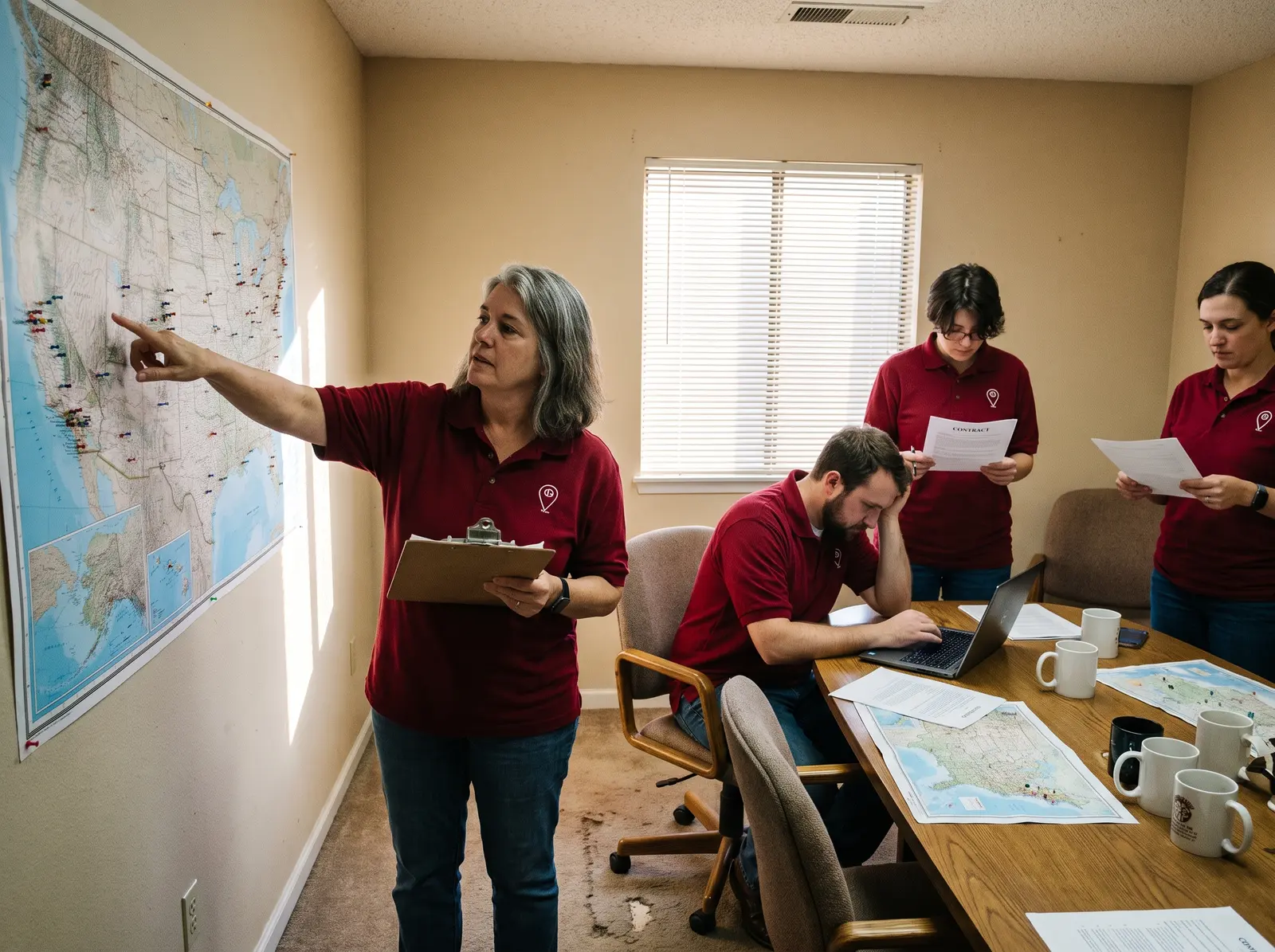
Everything that follows is a structure you can fill in and hand to a lender, with one section written harder than the rest. Pinpoint's numbers here are our own scouting data as of 7 September 2026: 26,311 venues scouted and qualified, 329 signed host agreements, 185 machines placed. Every figure that is not ours is linked to its source.
What does a vending machine business plan need to contain?
A vending machine business plan contains six working sections. The SBA's traditional plan format lists nine — executive summary, company description, market analysis, organization and management, product line, marketing and sales, funding request, financial projections and appendix — and a vending plan maps onto it cleanly, with one addition that general templates do not have a slot for: how you will actually get machines into buildings you do not own.
| Section | What it answers | The input that matters most |
|---|---|---|
| Executive summary | What the business is, in one page | Machine count and target venue type |
| Market analysis | Who buys, where, and from whom | Venue categories in your drive radius |
| Operations | Who services the machines, how often | Route time per machine per week |
| Location acquisition | How you get placements | Qualified contacts per signed agreement |
| Financial projections | What money goes in and when | Every input, labelled as an assumption |
| Risks | What kills this business | Placement failure, theft, venue churn |
Write them in that order. The executive summary gets drafted last even though it sits first, because it is a summary of the other five and nothing else.
What do lenders actually require in the plan?
Lenders reading a vending plan care about two things: can you repay, and have you thought about how you get revenue. The SBA microloan programme lends up to $50,000, with an average loan of about $13,000, rates generally between 8% and 13%, and a maximum seven-year term. SBA itself is explicit that "SBA-approved lenders make all credit decisions and set all terms for your microloan," so requirements vary by intermediary.
In practice that means the written plan is the intermediary's ask rather than SBA's. The VendBuddy template puts it plainly: lenders, "including the SBA Microloan program that funds most vending startups — require a written plan with financial projections before approving anything," and it adds that "a 20–30% owner equity contribution alongside the loan request significantly improves approval odds" (VendBuddy). Call your intermediary before you write, and ask what they want to see. Most will name a monthly cash-flow schedule for the first 12 to 24 months.
What placement rate should the location acquisition section assume?
The placement rate is the number of venues you must approach to sign one, and it is the single assumption that decides whether a vending business plan is honest. The templates currently ranking for this query either state a rate that is far more optimistic than our own experience, or leave the input out entirely. Both failures matter, because every timeline and cash figure below it is downstream of this number.
Here is what the ranking templates actually say, checked against the live pages in September 2026:
- VendBuddy states the figure outright: "1 placement per 10–15 cold contacts is realistic for beginners" (VendBuddy).
- VendSoft tells you to write down "how you'll get placements (cold outreach, referrals, property managers, local partnerships)" and to track "how many outreach attempts per week," but publishes no conversion figure (VendSoft).
- LivePlan's sample plan places eight machines across three named Fort Collins venues and says each placement "is secured through a revenue-share leasing agreement with the property owner." It does not disclose how many venues were approached (LivePlan).
- BizPlanner's twelve-section template has no location-acquisition content at all; its only location language refers to the operator's own premises (BizPlanner).
Pinpoint's own funnel runs at one signed agreement per 80 venues scouted and qualified: 329 signatures from 26,311 venues. Against VendBuddy's 10 to 15, that is between five and eight times longer.
Be fair to the published number, though. "Cold contacts" is not the same denominator as "venues scouted and qualified." Our 26,311 counts every venue our team researched and judged worth approaching, including the ones where nobody ever picked up, the decision-maker was never in, or the chain forbade third-party machines at head-office level. A walk-in to a pre-qualified venue with the owner standing at the counter is a completely different event from a cold scout, and its yes-rate is far higher — one vending newsletter puts in-person pop-ins at roughly three in ten (Vendpreneurs). If VendBuddy's 10 to 15 describes contacts that reached a decision-maker, it is defensible and ours is simply measured earlier in the funnel.
What is not defensible is a plan that never says which stage it is measuring. Your own rate will land somewhere between the two and will differ from ours — different city, different venue mix, different pitch. State the number, state the stage, and cite where it came from. The full stage-by-stage breakdown of our funnel is in how many businesses you pitch to land a vending location.
How does the placement assumption change the timeline and the cash?
The placement assumption changes a vending plan's timeline by a factor of five to eight, which is the difference between a plan that works and one that runs out of money in month four. Take an operator scouting 20 qualified venues a week — a real pace for someone working evenings and Saturdays — and run the same route target under both assumptions.
| Assumption | Contacts per signature | Weeks to 1 placement | Weeks to 5 placements |
|---|---|---|---|
| Published template rate (1 in 15) | 15 | 0.75 | 4 |
| Pinpoint scouting rate (1 in 80) | 80 | 4 | 20 |
Every figure in that table is an assumption, including the 20-venues-a-week pace. It illustrates sensitivity, not a forecast.
The cash consequence is the point. A plan built on four weeks to five machines budgets one month of insurance, storage and loan payments before revenue starts. A plan built on twenty weeks budgets five. If your plan cannot survive the pessimistic row, it is not a financing case, it is a hope. And signature is not installation: across our 157 currently open signed venues, the median wait between a venue signing and a machine arriving is 62 days, with a maximum of 108. Build that gap into the schedule too.
How do you write the location acquisition section itself?
The location acquisition section is a written operating procedure, not a paragraph of intent. Four things belong in it, in this order: which venue types you are targeting and why, how you reach the decision-maker, what you offer the venue, and the contacts-per-signature assumption with its source. A lender who reads only this section should be able to predict your first six months.
- Target venue types. Name two or three. Ours cluster in family entertainment: of the 90 open venues that carry a category label, 18 are bowling alleys, 15 indoor playgrounds, 10 family entertainment centres and 7 trampoline parks. Demand is uneven by geography too — see vending machine demand by state.
- Reach method. Walk-ins, phone, email, property managers, or a placement service. Say which, say how many attempts a week, and be honest that email is the weakest of them.
- The offer. Venues take a share of machine revenue after expenses. Across the 85 Pinpoint host agreements that state one, 56 sit at 40% and 14 at 50%. Write your number down and hold to it.
- The paperwork. A signed agreement with term, exclusivity, service schedule and exit. Start from a vending machine contract template rather than a handshake.
- The assumption. One line: "This plan assumes X qualified contacts per signed agreement, based on [source]." Then a sentence on what happens if it is wrong.
How do you write financial projections without promising revenue?
Financial projections in a vending machine business plan are a set of labelled assumptions, not an expectation of earnings, and the section lead should say so before the first number appears. Pinpoint publishes no earnings figures and makes no income claims. We charge a refundable deposit and we operate under the FTC Business Opportunity Rule, which governs what a seller may say about what a buyer might earn. Any revenue figure in your plan is yours to defend.
Build the sheet from inputs you can source, and mark each one:
- Machine cost — assumption; get a current quote, do not use a blog range.
- Product cost of goods — assumption; from your own supplier pricing.
- Venue revenue share — assumption; 30% to 40% after expenses is what Pinpoint's agreements run at.
- Placement service or locator cost — assumption; Pinpoint's is a $1,000 refundable deposit plus a monthly licence fee once a machine is installed and earning, listed in full on pricing.
- Gross sales per machine per month — assumption, and the shakiest one. The published ranges, and why they vary so widely by venue, are in how much do vending machines make. Treat them as third-party ranges, not as your forecast.
- Sales tax — assumption that depends entirely on your state; see vending machine sales tax by state.
- Route cost — assumption; miles and hours per service visit, which is a function of how far apart your machines are. Vending machine service radius covers the trade-off.
Then run the whole sheet twice: once at your base assumptions, once with the placement rate five times worse. Show both. A lender who sees the pessimistic case modelled trusts the optimistic one more, not less.
What risks belong in a vending machine business plan?
The risk section of a vending machine business plan should name the four failures that actually end vending businesses, not generic market risk. Lenders read this section for evidence that you have imagined losing. Each risk gets a sentence on likelihood and a sentence on what you do about it.
- Placement failure. The machine is bought and there is nowhere to put it. This is the most common and most expensive first-year mistake; the mitigation is securing the venue before the equipment, or using a service that holds signed venues.
- Venue churn. A host closes, renovates, or ends the agreement. Mitigation is a written term and a second candidate venue already scouted in the same radius.
- Underperforming site. Foot traffic was overstated. Only 71 of our 157 open venues report a visitor count at all, which tells you how often this number simply does not exist; the mitigation is a trial period and a relocation clause.
- Service and cash risk. Theft, vandalism, machine downtime, and the cash float. Mitigation is insurance and cashless payment.
Work through the operational side of all four with the vending business startup checklist before you finalise the plan, and read the broader context in how to start a vending machine business.
Frequently asked questions
Do you need a business plan to start a vending machine business? Not legally. You need one if you want borrowed money. SBA microloans are made through intermediary lenders who set their own credit terms, and a written plan with financial projections is the normal ask. If you are self-funding a single machine, a one-page plan with a scouting target and a cash floor is enough.
How long should a vending machine business plan be? Long enough to answer six questions and no longer. Ten to fifteen pages covers the executive summary, market, operations, location acquisition, financial projections and risks for a route of one to ten machines. Padding does not help; a lender reads the numbers and the location-acquisition section, and skims the rest.
What goes in the location acquisition section of a vending business plan? Your target venue types, how you will reach decision-makers, what you will offer the venue, and the assumed number of qualified contacts per signed agreement. That last input is the one most templates leave blank. State it as an assumption, show where it came from, and show what happens to your timeline if it is wrong by a factor of five.
What placement rate should a vending machine business plan assume? State a range, not a single number, and say which stage it measures. Pinpoint's own scouting funnel signs one venue per 80 qualified venues, measured at the qualification stage before anyone has spoken. Published templates quote one placement per 10 to 15 cold contacts, which describes a narrower pool. Model both and see whether the plan survives the pessimistic one.
Can a vending machine business plan include projected revenue? It can, and lenders expect it, but every figure in it is an assumption rather than a forecast of what you will earn. Label it that way in the section lead and under the table. Pinpoint publishes no earnings figures and makes no income claims; the ranges in any plan come from third-party sources you should cite and sanity-check yourself.
Your next step
Write the location-acquisition section first, and decide before anything else whether you are scouting venues yourself or starting from ones that have already signed. That choice sets the contacts-per-signature line, the timeline, and the cash the plan has to carry. See what a signed venue costs and what the deposit covers on pricing.
Zach Downey runs Pinpoint Vending, which scouts and negotiates venues for vending machine operators. Figures in this article come from Pinpoint’s own scouting data and cited third-party sources; Pinpoint makes no representation about the income any operator will earn.
Keep reading
Vending Machine Sales Tax by State (2026): 20 States
Vending sales tax differs by state: 33% of receipts in California, 57% in Washington, 50% in Texas. The rule for 20 states, from revenue departments.
Micro Markets vs Vending Machines: Which Can You Start?
Micro markets out-sell machines but need a closed workplace, $15K–$50K, and 2–10% shrink. The honest comparison for a first-time operator.
How Often to Restock a Vending Machine (2026 Method)
How often to restock a vending machine is capacity divided by daily sell-through, not a weekly route. The arithmetic, plus venue foot traffic.