

Cotton Candy Vending Machine Locations: What Venues Want
A cotton candy vending machine location almost never costs rent. The venue takes a share of what the machine sells instead, calculated after cost of goods, and expects the machine to arrive, get serviced and stay clean without becoming their problem. The share is what operators negotiate. The cleaning duty is what they should negotiate.
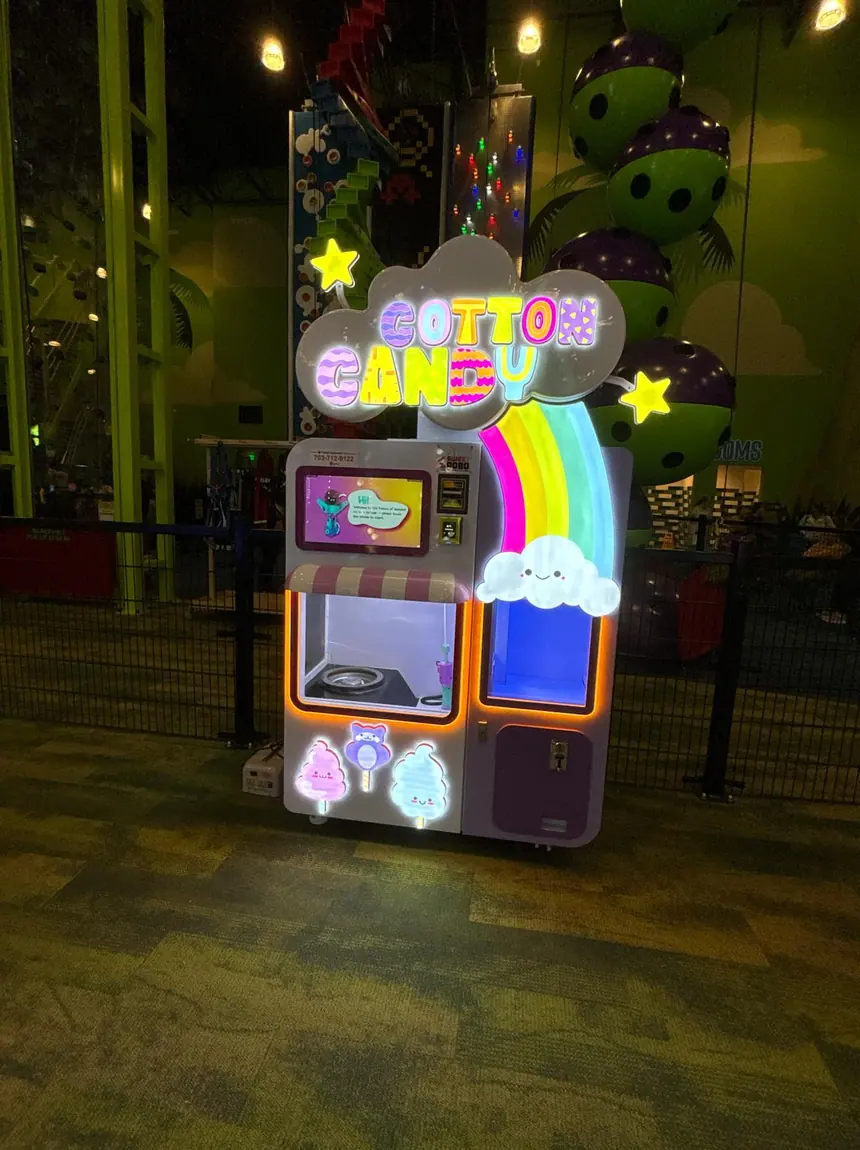
Most pages about cotton candy machine placement are written by people selling the machine, and they stop at a list of venue types. This one starts after that decision: what a venue actually asks for in return for the floor space, and which of those terms will move if you push. If you are still choosing a venue type, our ranking of where to put a cotton candy vending machine covers that question and this post covers the terms.
What does a cotton candy vending machine location cost?
A cotton candy location costs a share of revenue rather than rent. Pinpoint's published terms state it as typically 30–40% of machine revenue to the venue, after cost of goods, with the exact figure shown on each location before you choose it. Venues with heavy general traffic and no particular interest in the machine ask for more; venues built around children ask for less, because they want the machine there.
"After cost of goods" is doing real work in that sentence. The share comes out after the fixed per-item cost written into the venue's agreement, not after your expenses in general, and card processing fees stay with the operator. Those two details change the economics more than a few points of share do, and they are the ones most likely to be vague in a contract someone hands you.
Almost nobody rents the floor space outright. If you are searching for a spot to rent rather than a share to pay, you will mostly turn up lead brokers rather than venues. For how share rates compare across machine types and venue categories, see how much vending machine owners pay locations.
Who cleans a cotton candy vending machine?
Cleaning duty is the term operators skim past and the one most worth reading. Day-to-day cleaning is normally the operator's responsibility unless the venue's agreement specifically hands it to the venue, and both versions are common. Pinpoint states which way it falls on each location before you choose it, because it changes the job as much as the share does.
The reason it matters more for this machine than for a snack machine is the product. Spun sugar is sticky, it travels on fingers, and it ends up on the floor around the machine rather than in a bin. A venue manager knows that before you finish your sentence.
So the cleaning clause is not a footnote. It is the clause the venue is quietly pricing while you talk about percentages, and it is the one you can trade.
Should you offer to clean the machine yourself?
Offering to clean the machine is the strongest card an operator holds in a cotton candy negotiation, and it is worth playing deliberately rather than conceding later. A venue that takes the cleaning on is doing labour for you every day, and it will want compensating in the share. A venue that hands the job back to you has less ground to argue for the higher end of the range.
The real cost of that offer is the trip, not the cloth. If you are already visiting weekly to restock, cleaning adds minutes and the trade is clearly worth making. If the venue sits at the edge of your service radius and you were planning to visit less often, the cleaning duty is what forces the extra drive, and letting the venue keep the job may cost less than the fuel.
Scale flips it again. With one machine, clean it yourself and keep more of the revenue. Across a route spanning several states, the venues that clean are the ones that let you keep the route at all.
Which way you go should be a decision, not an accident. Bring it up before the venue does.
Which venue types ask for the least?
Venues built for children generally ask for less than venues that merely have traffic. Bowling alleys, indoor playgrounds, family entertainment centers and trampoline parks treat a cotton candy machine as something that improves a birthday party, so they want it in the building and price the space accordingly. These are also the venues where the machine performs best, which is a rare case of the cheapest option also being the right one.
High-traffic retail works the other way. A gas station, a mall concourse or a general retailer is renting you a square metre and has no particular stake in what sits on it, so the share runs higher and the audience is worse. Birthday parties made up 14% of family entertainment center revenue in the 2025 revenue mix compiled by Embed, which is why the party venues treat the machine as an amenity rather than a tenant.
Staffed venues are also the ones most able to take the cleaning on, because somebody is already closing the place down each night. That is worth knowing before you decide which side of the cleaning trade to open on.
Ranking which of these venues to want is a different question from what they charge, and our guide to cotton candy venue types ranks them on dwell time and audience. For the family entertainment category specifically, see vending machines in family entertainment centers.
What do venues object to before they sign?
Venues raise three objections to a cotton candy machine, in a consistent order: the floor, the humidity and the power. The floor decides the deal, because the manager is picturing sticky carpet at closing time. The cleaning clause is the answer to that objection, which is exactly why it is worth more in a negotiation than its place in the contract suggests.
Humidity is the objection that should change where the machine goes rather than what it costs. Spun sugar pulls moisture out of the air, so a damp spot produces limp cones and a clogged head. That rules out pool decks, uncovered entrances and anywhere a door opens onto wet weather all day. Water parks and campgrounds still work, but only with the machine inside a dry building.
Power is usually the easiest objection to clear: the machine runs off a standard outlet, and what the manager is asking is whether they are paying an electrician. Say no early.
The objection nobody raises in a play venue but everyone raises in a school, hospital or gym is sugar policy. Those venues are a different conversation, covered in where you can legally put a vending machine. A cotton candy machine is not the machine for a wellness-policy building, and pitching it there wastes the visit.
How do you get a cotton candy vending machine location?
Getting a cotton candy location takes one of two routes: pitch venues yourself, or have one scouted and signed for you. Pitching yourself means a list of indoor play venues inside your service radius, a one-page proposal, and catching a manager who is actually on shift. Expect a lot of visits per yes, and expect the cleaning question in the first five minutes.
If you pitch yourself, bring the cleaning answer with you rather than waiting to be asked. Our placement proposal template and the vending machine location agreement cover what to put in front of them, and the pillar guide to how to find vending machine locations covers the whole process end to end. If you want a sense of how many doors that takes, how many businesses you have to pitch is the honest version.
The alternative is that the scouting and the negotiation are already done. Pinpoint presents qualified locations with the venue share and the cleaning term printed on each before you choose.
FAQ
What do cotton candy vending machine locations charge? Most venues take a share of revenue rather than rent, and Pinpoint's published terms put that at typically 30–40% to the venue, after cost of goods. Child-focused venues tend to sit at the lower end, high-traffic retail at the higher end.
Who cleans a cotton candy vending machine? Either party, and the agreement decides which. Day-to-day cleaning is normally the operator's job unless the venue's agreement hands it to the venue. It is one of the most negotiable terms in the whole agreement.
Are there cotton candy vending machine locations available near me? Availability changes constantly and varies by state. The marketplace lists the venues that are currently open, with the venue share shown on each one before you choose it.
Can a cotton candy vending machine go outdoors? Not in the open. Spun sugar absorbs moisture, so humidity ruins the product and clogs the head. Outdoor venues work only when the machine sits inside a dry building such as an entry hall or a food court.
Do you need a contract for a cotton candy vending machine location? Yes. The agreement is what fixes the venue's share, the cleaning duty and the cost-of-goods figure the share is taken after. Without those three in writing, the cleaning duty is the one that gets disputed first.
Next step
If you own a cotton candy machine or are about to buy one, the terms above are what you are negotiating, and cotton candy vending machine placement shows the venue types that take one. Pinpoint's vending machine location service presents up to 2 qualified locations with the venue share and cleaning duty shown on each before you choose. It is $1,000 to start — an $800 refundable deposit plus a $200 processing fee — the placement fee is $100 a month, first due a month after you sign for a location, and everything you paid comes back, with a further $1,000, if we have not presented you a location within 6 months. Full terms are on the pricing page.
Zach Downey, Pinpoint Vending, runs Pinpoint Vending, which scouts and negotiates venues for vending machine operators. Figures in this article come from Pinpoint’s own scouting data and cited third-party sources; Pinpoint makes no representation about the income any operator will earn.
Keep reading
Vending Machine Spots: Rent, Commission or Free? 2026
Vending machine spots are almost never rented. Across our signed host agreements, every one pays the venue a share of revenue — none pays flat rent.
Vending Machine Placement Proposal: Free Template 2026
A one-page vending machine placement proposal you can copy, with every number in it benchmarked against host agreements venues have actually signed.
Pokémon Card Vending Machine Business: Rules and Venues
A Pokémon card vending machine business runs on your own machine, since official ones aren't for sale. Sourcing, counterfeits, mystery-pack law, venues.